

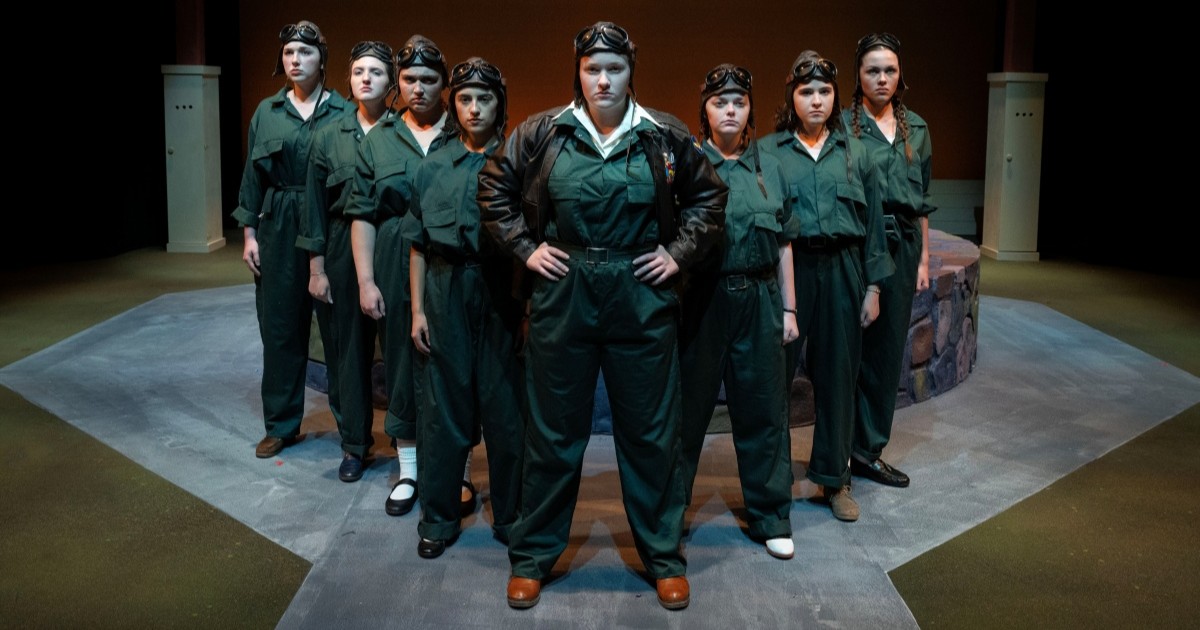
When ETSU students Talon Mincieli and Lillian Calhoun joined the cast of “Decision Height,” neither knew much about the Women Airforce Service Pilots (WASPs) whose experiences inspired the play.
That changed quickly.
“I don’t think I knew that they existed before,” said Mincieli, who plays Eddie Harknell. “I was really surprised by how many women already had pilot’s licenses, especially that early in time.”
East Tennessee State University’s Department of Theatre and Dance hopes those who attend the performance, which opens on Thursday, Oct. 1, will leave with a similar appreciation for the experiences and sacrifices of the WASPs.
“Decision Height,” written by Meredith Dayna Levy, will run Oct. 1-4 in the Bert C. Bach Theatre at the ETSU Martin Center for the Arts.
Set during World War II, the all-female play follows Virginia Hascall, who leaves her home and fiancé to train as a WASP. Alongside women from different backgrounds, Virginia learns about duty, sacrifice and honor while creating lifelong bonds with her counterparts and discovers who she really is and who she must become.
Tickets are available at https://bit.ly/4dDGIMv. Discounted student tickets may be purchased at the Martin Center Box Office.
A story worth telling
Director Bobby Funk has long been interested in World War II history. His mother, Betty Horner, served as a sergeant in the Women’s Army Corps during the war. While serving in France, she met Paul Funk, a staff sergeant in the U.S. Army’s 78th Infantry Division, and the two married upon their return to the United States after the war.
That personal connection drew him into the history behind “Decision Height.”
“When I began to research the WASP program, I found it just fascinating,” said Funk, a professor of acting in the Department of Theatre and Dance. “I think it’s a story that needs to be told.”
The students had a similar experience as they learned about the women behind the production.
Calhoun, who plays Virginia, was particularly struck by the sacrifices the pilots made and the lack of recognition they initially received for their service.
“All these women paid their way to get there, spent all this time, risked their lives and left their families,” Calhoun said. “How awful is it that we didn’t even know they existed?”
The WASP program was deactivated in 1944, according to the National Museum of the United States Air Force, but the women who served weren’t officially recognized as veterans until 1977. And it wasn’t until 2002 that they were eligible for burial in Arlington National Cemetery.
Different ways to be strong
For Mincieli, the play also reveals how, despite their differences in backgrounds and beliefs, the women were united by a desire to serve their country.,
“They’re all very different women, but they still have the flying thing that unites them,” they said.
Those differences became one of Mincieli’s favorite parts of the play.
Eddie is a rule breaker with a complicated personal life, while the other women arrive at training with their own backgrounds, ambitions and ideas about what comes next.
“For some people, the strength is staying. For some of them, it’s leaving. For some of them, it’s returning to the past. For some of them, it’s going to the future,” Mincieli said. “I really like that this play shows that all of those are powerful and strong.”
For Calhoun, Virginia’s journey is about gradually choosing the life she wants for herself.
Throughout the play, Virginia writes letters to her fiancé, William, who wanted her to remain home. As she becomes closer to the women around her, Calhoun said, Virginia also becomes more certain of her own direction.
“It’s the entire story of her choosing herself over and over again,” she said.
The camaraderie portrayed onstage has developed naturally among the cast, too.
“It kind of happens naturally when you’re in a cast this small, especially in a script that’s about friendship,” Mincieli said.
Bringing Avenger Field to the stage
The production also draws heavily on the history of Avenger Field, where women trained to fly the “Army way.”
Scenic designer Jonathan Taylor centered the set around the field’s wishing well, which Funk noticed in numerous historical photographs during his research. The well served as a gathering place for the women and serves as the visual center of the ETSU production.
“The well is the base,” Funk said. Pieces of the set then transform into sleeping quarters and even the aircraft the women fly.
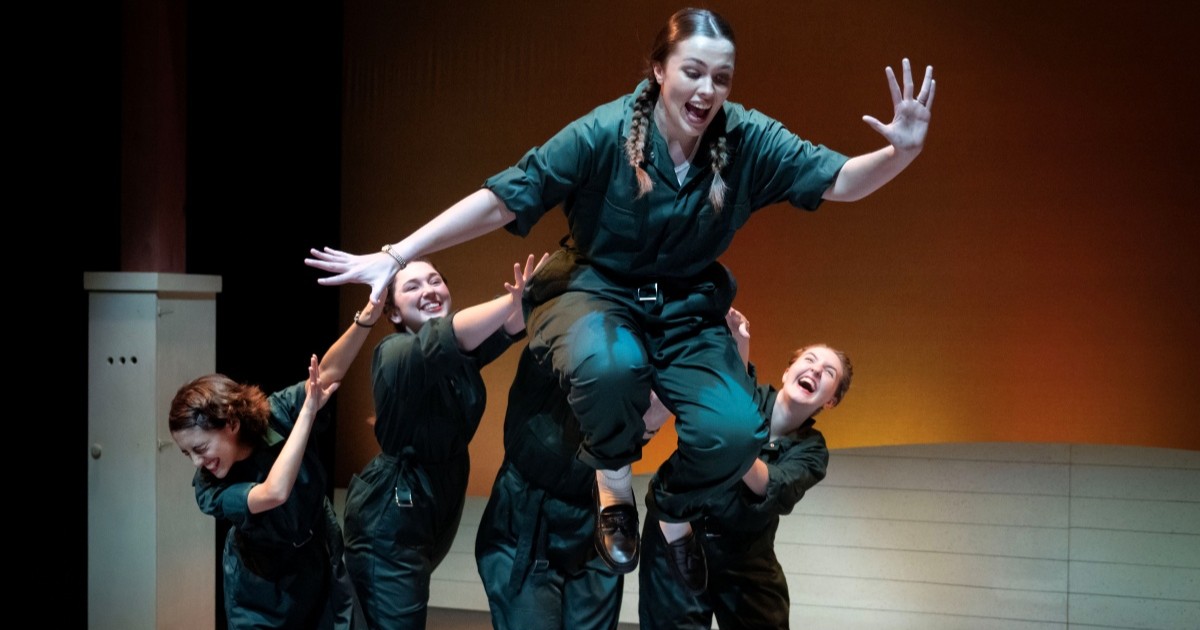
Costumes by Karen Brewster help establish the period, while songs throughout the show draw from the marching songs sung by the women at Avenger Field.
For Funk, bringing those details together is another way to introduce audiences to a history many may never have encountered and honor the 38 women who lost their lives serving their country as part of the program.
“It’s been rewarding to see young people get involved in a piece of history that a lot of people don’t know,” he said.
Calhoun hopes audiences leave knowing more about the women whose experiences inspired the story.
“This is such an important part of history and of women’s history,” she said.
The ensemble is comprised of ETSU students Calhoun, Mincieli, Ella Aberman (Rosalie), Taylor Boyle (Ziggie), Lydia Bridgforth (Mildred), Aviia Hawkins (Mrs. Deaton), Shelby Holsberry (Carol), Sophia Hyder (Alice) and Lyssabeth Tatum (Norma Jean).
“Decision Height” runs Oct. 1-4 in the Bert C. Bach Theatre and the ETSU Martin Center. Tickets are available online at https://bit.ly/4dDGIMv or at the Martin Center Box Office, open Monday-Friday from 10 a.m.-2 p.m.


%20(1).avif)