

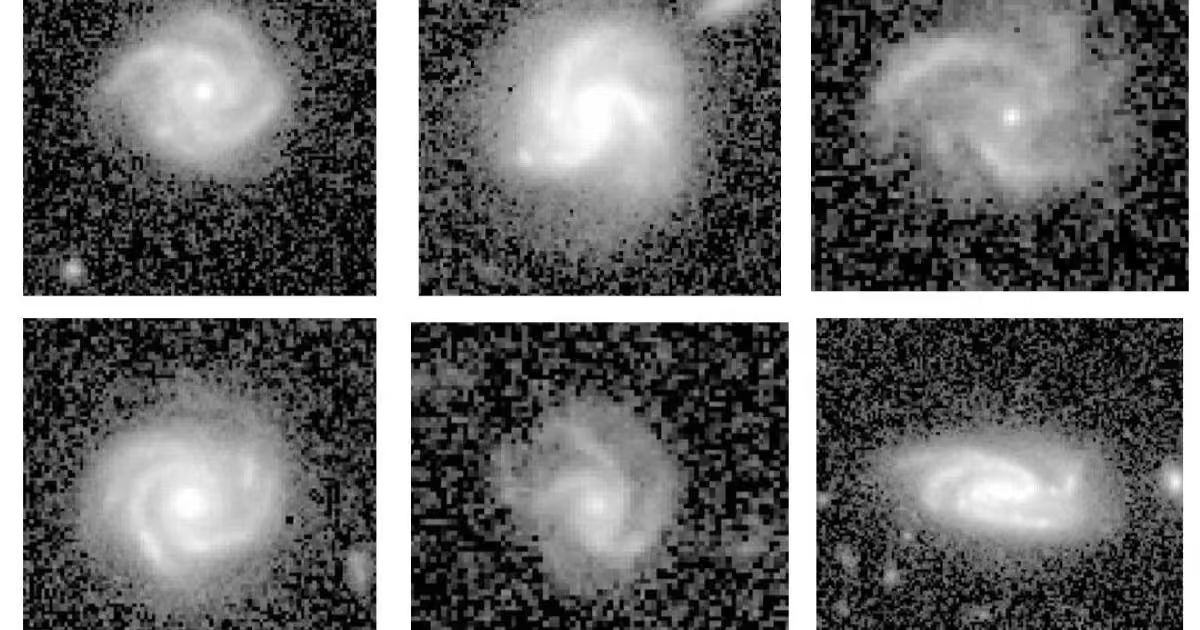
For generations, astronomers have been puzzled by a deceptively simple question: Why do some spiral galaxies have two arms while others have many?
Researchers at East Tennessee State University, in collaboration with Iowa State University, believe they have uncovered an important piece of the answer. The research, published in the Astrophysical Journal this month and supported by the NASA Tennessee Space Grant Consortium, suggests the answer lies in the central bulge, the dense collection of stars at the core of a galaxy.
Their findings shed light on how galaxies form and evolve and may provide astronomers with a new way to better understand dark matter, which NASA describes as the “invisible glue” holding the universe together.
“Spiral galaxies are among the most recognizable objects in the universe, yet we've never fully understood why they develop different numbers of spiral arms," said Dr. Beverly Smith, project lead and professor in the Department of Physics and Astronomy in the College of Arts and Sciences.
“By studying thousands of galaxies, we're beginning to identify patterns that reveal how these systems formed and evolved over billions of years.”
Smith said their team analyzed images of galaxies captured by the European Space Agency’s Euclid space telescope. Because Euclid’s images are significantly sharper than those from ground-based telescopes, it was able to distinguish spiral arm structures in galaxies billions of light-years away – allowing astronomers to see galaxies as they appeared when the universe was half its current age.
The ETSU and ISU team found that galaxies with larger central bulges – such as the Milky Way – almost always have two dominant spiral arms. In contrast, galaxies with smaller, flatter centers tend to have numerous spiral arms.
Their observations closely matched predictions from computer simulations of galaxy formation. In essence, the more centrally compact the galaxy, the fewer arms are produced.
The total mass of a galaxy also plays a role, influencing the length and prominence of the spiral arms. Because the overall distribution of matter – including dark matter – helps shape spiral structure, Smith’s team believes counting the number of spiral arms in a galaxy may offer a new way to estimate the amount of dark matter concentrated at its center.
“The number of spiral arms turns out to be more than just an interesting feature – it reflects what's happening deep within the galaxy itself,” Smith said. “That's exciting because it gives us another tool for understanding parts of the universe we can't observe directly, like dark matter.”
The project also provided a hands-on learning opportunity for ETSU student Sydnie Bergner, an undergraduate physics major. Bergner participated in the study last summer.
“Working with Dr. Smith and getting the opportunity to involve myself in research early was an honor that I never expected when considering my college career,” said Berger. “It’s become the launching pad for my career in physics research, something that has carried me to further opportunities, and an experience I’ll never forget.”
Also contributing to the research were ETSU professor Dr. Mark Giroux and Dr. Curtis Struck, professor emeritus at ISU.
The study reflects ETSU's commitment to expanding research opportunities for students while advancing discoveries that contribute to scientific understanding around the world. Learn more about ETSU’s commitment to advancing research at etsu.edu/trailblazers. Smith's research is available to view online at https://bit.ly/4ymB2zd.
.avif)