

Why do some memories fade while others linger for years?
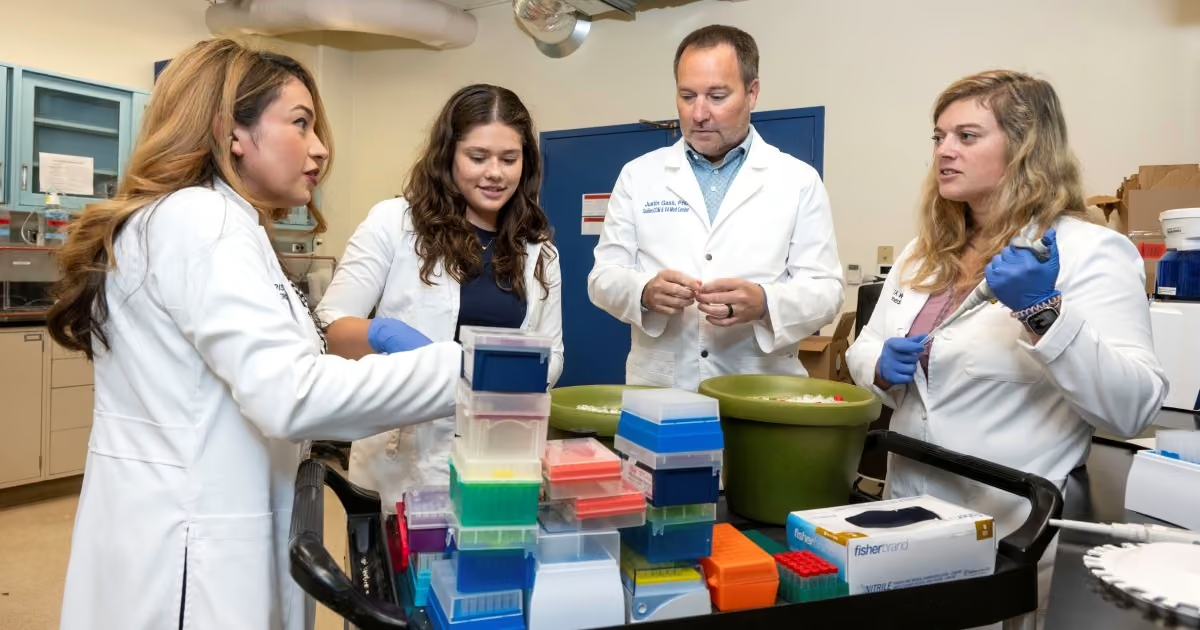
For Dr. Justin Gass, that question is at the center of his research at East Tennessee State University.
An addiction neuroscientist at ETSU’s Quillen College of Medicine, Gass studies how alcohol alters the brain in ways that make addiction recovery more difficult. His work focuses on understanding why certain cues – such as a place, smell, social setting or time of day – can trigger cravings and lead to relapse long after someone has stopped drinking.
“Alcohol use disorder is not simply about poor choices or willpower,” said Gass, a professor in Quillen’s Department of Biomedical Sciences. “It involves changes in brain circuits that regulate motivation, stress, memory, decision-making and emotion.”
Gass’ research specifically examines how alcohol affects the brain’s ability to form new, healthier associations to move beyond harmful patterns of behavior.
“A simple way to say it is that my lab studies why the brain has such a hard time ‘unlearning’ alcohol-related memories,” Gass said. “Unfortunately, the brain is a very good student – sometimes too good.”
Gass, who holds an undergraduate degree from ETSU and is from Elizabethton, returned to the institution as a researcher in 2020, driven by a desire to study issues that deeply affect his home region. He is also spearheading an initiative at ETSU to establish a Center for Neuroscience, which will focus on the neurobiological mechanisms of opioid addiction and its relationship to the brain and nervous system.
"What attracted me was the opportunity to build addiction neuroscience in a place where the work really matters," he said. "East Tennessee and Central Appalachia have been deeply affected by substance use disorders, and ETSU has a strong mission around rural health, community engagement and training the next generation of health professionals.
“For me, that combination was very compelling,” Gass continued.
His current research zeroes in on the overlap between alcohol use disorder and post-traumatic stress disorder (PTSD), as well as how alcohol use as an adolescent may lead to vulnerability to PTSD later in life. Recently, Gass and his team have been exploring co-use, such as ways mixing alcohol and THC, the psychoactive component in marijuana, may affect drinking behavior.
That research is greatly aided by the students in his lab, including undergraduate, graduate, and postdoctoral trainees, who are investigating topics ranging from the biology of relapse to the effects of chronic stress on the brain.
“I am very proud of the work my trainees have done,” said Gass. “It is very rewarding to train others, and watching a student move from learning basic techniques to asking their own scientific questions is one of the best parts of this job.
“We are not just producing data,” Gass added. “We are training the next generation of scientists and clinicians. To me, that’s a little more impactful than any one manuscript.”
Ultimately, Gass and his team are committed to finding treatments and solutions for those battling alcohol use disorder.
“If we can identify the brain circuits and biological processes that make relapse more likely, then we can develop better medications, better behavioral therapies and better ways to match treatments to each patient,” Gass said. “Science is not usually a lightning bolt moment; it is more often a slow accumulation of evidence.
“But those small steps matter,” he continued. “Every experiment helps us understand a little more about why recovery is so difficult and how we might make it more successful.”
As ETSU continues to expand its research enterprise, researchers like Gass reflect the university’s commitment, as the flagship institution of Appalachia, to finding solutions for the region’s most pressing health challenges.
Learn more about ETSU’s commitment to research at etsu.edu/trailblazers.
.avif)